

Simone Weil and I
My curious relationship to a dead French mystic and how I became a Weil scholar

I’ve published scholarship on Simone Weil and because my name, too, is Simone (and I’m not from France, where the name is common), I’m often asked about my name and whether there is a connection between Kotva and Weil. There is. Here is the full story.
Before I was born, in the weeks leading up to my birth, my parents decided I was a Simone. Not just any Simone: my namesake was to be Simone Weil.
The final page of my parents’ pregnancy journal is scribbled in haste: “if you are a boy we will tear out this page. But if you are a girl your name will be Simone.”
So began my relationship to Weil — the French philosopher, syndicalist and rebel whose incurable Antigone complex led to her untimely death in 1943.
Some of my earliest memories are memories of Weil. Or rather, of Weil and I.
At first, her name was like a saint’s shroud, casting a protective veil over my existence. My mother, a visual artist, had painted an oil portrait of a spectacled Weil. Each day, Weil’s inscrutable gaze would greet me from her elevated vantage on our living room wall. Whenever I asked about Weil, my mother would point to the painting and reply that Weil had been a great mystic and would always impress on me that I had not been named after “that other Simone,” Simone de Beauvoir.
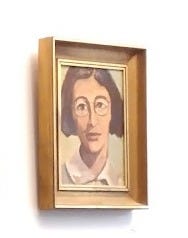
I was proud of Weil and proud of carrying the name of a “great mystic,” even though I hadn’t the faintest clue what that meant. I was also proud of not being named after de Beauvoir, even though I didn’t understand who she was either.
Despite being almost entirely ignorant of Weil’s identity, I exulted in the virtues of my namesake. I felt I would gladly have defended Weil’s name in court. It was Weil and I against the world.
I knew where to find Weil’s books in the family library and I would often touch their spines excitedly and open pages at random. I recognised her name, because it was also my name, with that same initial “S.” My letter. Her letter.
When I read her name I used to whisper: “Simone.” And I would imagine my own name on the spine of a book.
When I learnt how to read, I thought I should like to understand Weil better. Proud of my namesake (Weil had written books!) I remember opening Gravity and Grace and poring over its gnomic statements. I found them inexplicable, but arresting. I liked the sound of them. I let the words roll around in my mouth, tasting the syllabes.
In my early teens, my mother gifted me Simone Pétrement’s weighty biography of Weil. Another Simone, I thought, finding the preponderances of Simones around Weil strange and exciting (I didn’t grow up in France, where the name is common; I met my first Simone when I was 9 and the experience shook me to the core—until that moment, the only other real Simone had been Weil).
Leafing through Pétrement’s account of her dead school friend, I remember reading as far as the opening chapters on Weil’s childhood. The young Weil enthralled me. Her behaviour reminded me of the stories I’d read about the Fatima children, with their unruly, impetuous asceticism. The young Weil didn’t take no for an answer. She thought her actions had repercussions at a distance. She thought her actions mattered. To me, she seemed both sorcerer and saint.
I felt I had been gifted something illicit and powerful, like clandestine dynamite. A small explosion took place inside of me. From that moment on, Weil was present to me in an unspeakable, intimate way that, for the longest time, I never cared — or really dared — to articulate.
The years went by. Eventually, I chose to study theology at university and brought a copy of Weil with me, as a kind of talisman. I never opened it. She was simply there. That was enough.
Weil and I.
Throughout my undergraduate degree, Weil remained a kind of absent presence. I kept the copies of her books close but I successfully avoided addressing Weil in any of my course work or exams. Of course, Weil was popular among many of the theologians I encountered in my reading lists. I studied Iris Murdoch with enthusiasm and I understood her indebtedness to Weil’s notion of attention. I read the work of Janet Soskice, a professor at my Faculty, and saw traces of Weil.
But I steered clear. I wasn’t ready, yet, to open the door to that intimate space, the space of Weil and I.
Then came my postgraduate years, during which I faced the formidable task of wrestling a doctoral dissertation into shape. Halfway through my second year, I gave a presentation about Gilles Deleuze and Stoicism at a meeting of the Society for the Study of Christian Theology in York. I’ve since lost the script for that paper but I remember the final lines were about waiting and attending and how a certain kind of passive attention is an act of critique. I’d written those lines without thinking of Weil. And yet somewhere I’d always been thinking of Weil.
A member of the audience raised their hand. “This sounds a lot like Simone Weil,” they began: “have you thought of looking at her work in relation to your thesis?”
Keeping Weil’s work at a distance was no longer possible. I needed to open the door and see where I stood in relation to Weil.
When I returned home from the conference I went to the Faculty library and headed straight for Weil’s books. The first one I opened was Intimations of Christianity Among the Ancient Greeks. I finished it in one sitting.
I read Waiting on God, Gravity and Grace and then tackled the Notebooks. I read The Need for Roots. I read everything I could get my hands on — letters, essays, poems. My waking dreams were of Marseilles, of Carcassonne, of the New York Public Library…of Kent. The exchange between Weil and Joë Bousquet was impossible to put down (eventually, it formed the basis for a chapter in my dissertation).
I spent three weeks reading nothing but Weil. I surfaced punch-drunk and exuberant. The problems I had been struggling to articulate in my dissertation had not been resolved, but I had found a fellow struggler. Weil had been there before me and all I had to do was enter into the conversation with her: the endless conversation between Weil and I. I could see the lines of my argument unfolding, twisting and weaving into a narrative that finally had gained a form, an outline.
Although I had read passages from Weil as a child it was now, as a postgraduate, that I really sat down with Weil. But I noticed that as soon as her words had landed in my mind it was as if they’d always been there; as if they had merely needed to be woken to life. I understood what she meant, intuitively. I liked this about her voice: how matter-of-fact Weil was, how patient, how ready to explain every step of the way in her reasoning.
What had seemed gnomic to me as a child now made sense and also challenged me to see familiar concepts differently. Ludwig Wittgenstein once wrote that the impact of a text on the soul is equal to the reader’s stage of life. It was like that for me when I read Weil in my early 20s.
After opening the door to Weil and I, I let it remain open—for a while. Some of my first published articles were about Weil, and I let my namesake direct my research for about a decade. The final chapter of my first book ends with Weil-inflected thinking and its title, Effort and Grace, is an obvious nod to Gravity and Grace.
At conferences, people have sometimes introduced my work, jokingly, as “Simone on Simone.” Occasionally, I feel the need to say it’s not a coincidence. Mostly, however, I let it pass.

I suspect that Weil and I is a default state for me. In the spirit of Weil, who was forever tackling fresh ideas, my work is no longer principally “Simone on Simone.” But I still find that the concepts which have been most generative to work with emerged from readings of Weil, or readings inspired by Weil, even if Weil’s thought doesn’t always feature as an explicit theme in what I write.
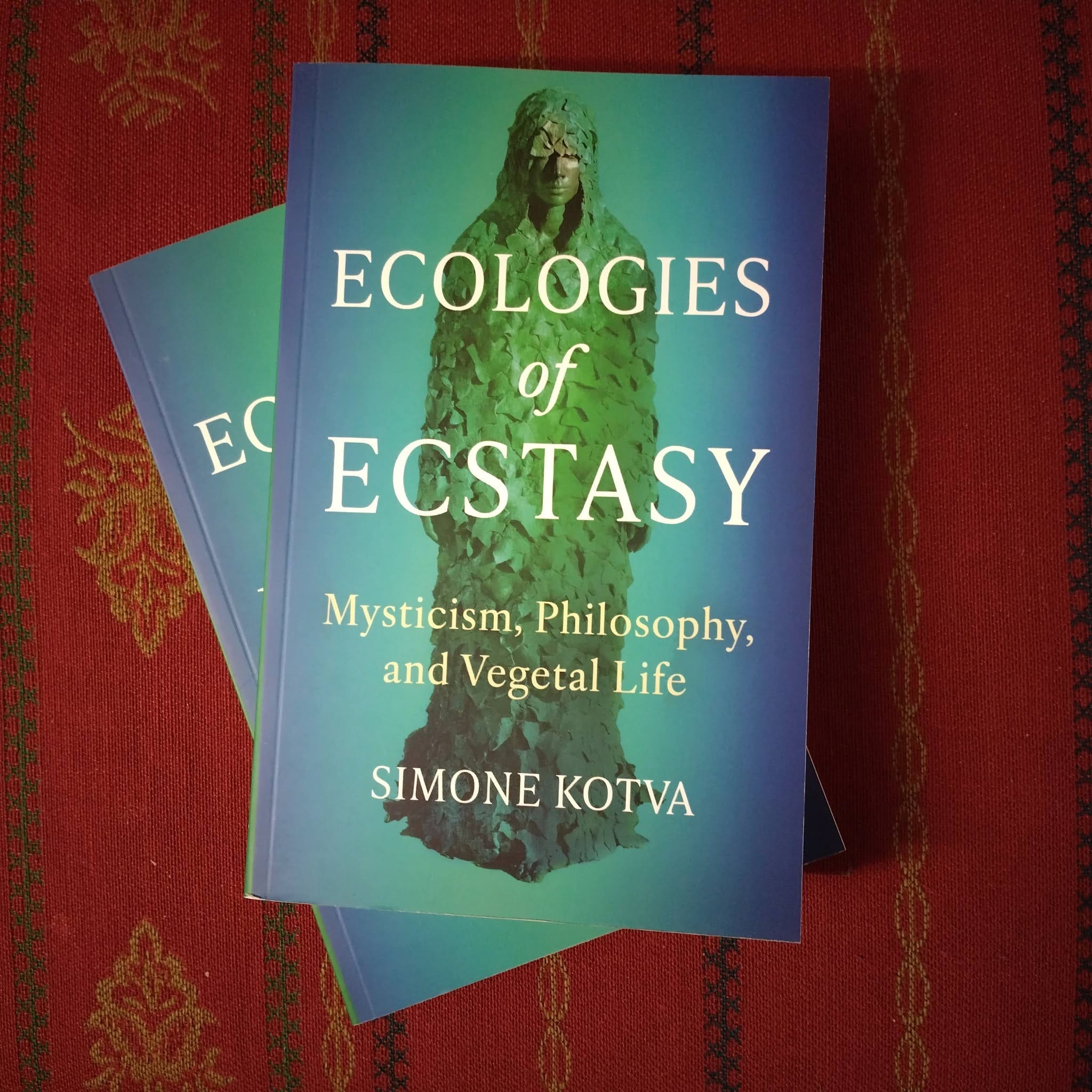
For instance, in Ecologies of Ecstasy, my second book, I momentarily return to Weil’s solar analogy in the epigram and epilogue. Ecologies of Ecstasy is about how mystics think of themselves as plants in relation to God, who is figured as the sun. Weil wrote that humans “are like plants that have the one choice of being in or out of the light.” Ecologies of Ecstasy is about the contemplation of vegetal life — and how vegetal life is an ongoing activity of contemplation. That’s an idea I once encountered in Weil, rediscovered in other texts, and often return to when I read Weil.
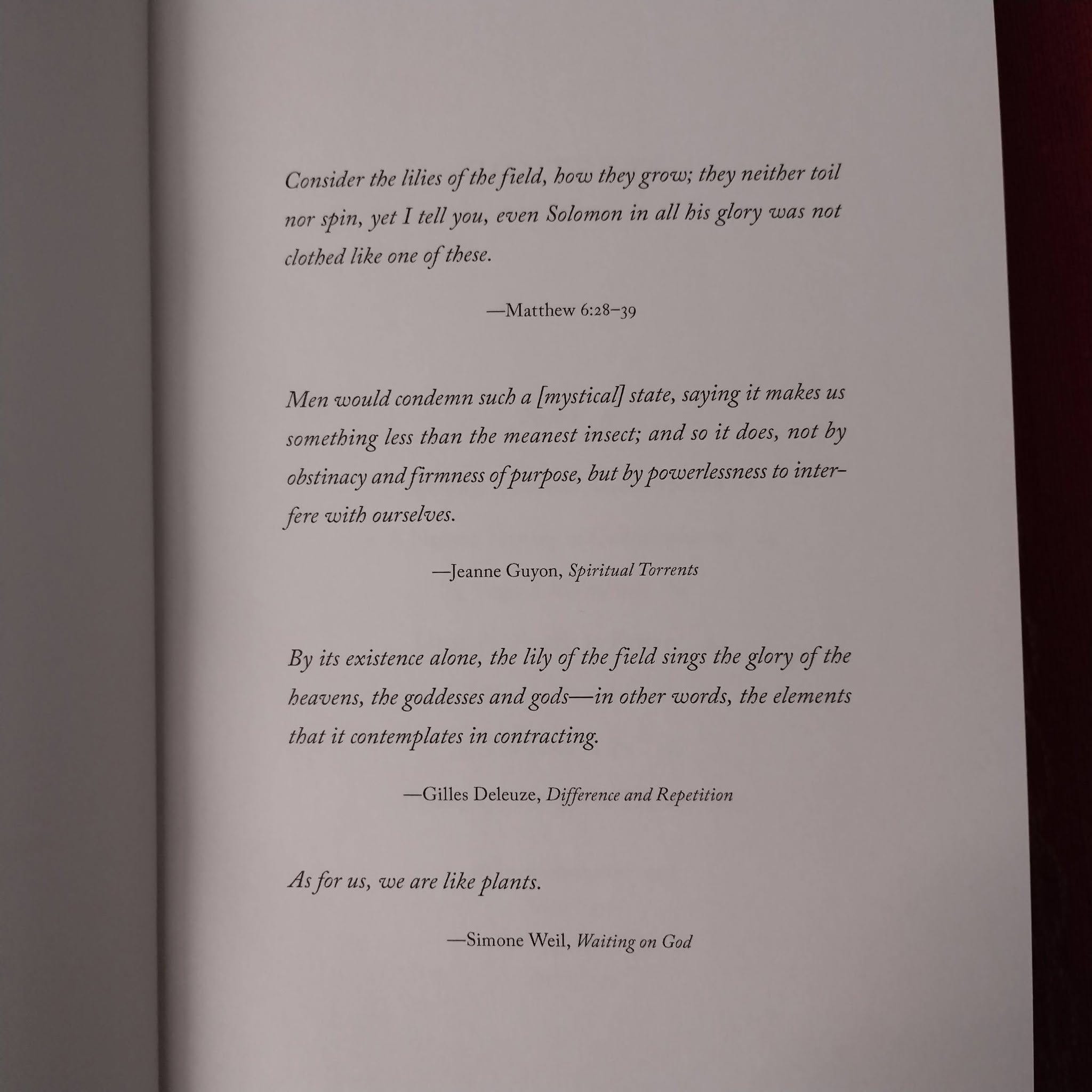
The project I’m working on at the moment — tentatively entitled Grace Energy — is also traceable to Weil’s thought. When Weil writes about what I call her “solar analogy,” she argues that grace is like solar energy, and compares its reception and activation to photosynthesis and the transformation of energy: “In the same way [as a plant grows],” reflects Weil, “the only effort we can make toward the good is so to dispose our soul that it can receive grace, and it is grace which supplies the energy needed for this effort.”
Is grace “energy”? If so, in what way? How does an energy model for thinking about grace shift our perception of what it means to talk about life as “gift”? And what are spiritual exercises (meditation and contemplation) when interpreted through the energy model?
The lines of my thought continue to intersect with those of Weil. A quotation, an image, a passage from her work will appear suddenly to my mind as I’m engrossed in what I think is something entirely unrelated to Weil’s concerns. I think of this as the continuation of our conversation — the conversation between Weil and I.
My work on Weil, in selection:
Kotva, S. 2027 [forthcoming]. “Alain.” In The Routledge Companion to Simone Weil. Eds. Deborah Casewell and Christopher Thomas. Routledge.
Kotva, S. 2025. “Alain” and “Method.” In The Bloomsbury Handbook of Simone Weil, ed. Lissa McCullough. Bloomsbury.
Kotva, S. 2024. “Work as the Spiritual Basis of Culture.” In A Declaration of Duties toward Humankind: A Critical Companion to Simone Weil’s The Need for Roots, ed. E. O. Springstead, pp. 245-274. Carolina Academic Press.
Kotva, S. 2021. “Kotva Replies: Thinking Through the Middle Voice.” Attention: The Life and Legacy of Simone Weil. [Online journal/resource. My response to Marie Cabaud-Meaney’s review of Effort and Grace, also published in Attention.]
Kotva, S. 2020. “The Occult Mind of Simone Weil.” Philosophical Investigations, 43(1–2), 122–141. https://doi.org/10.1111/phin.12264.
Kotva, S. 2020. Effort and Grace: On the Spiritual Exercise of Philosophy. Bloomsbury. [The Preface, Chapter 5 and the Epilogue are the relevant bits for those interested in Weil.]
Kotva, S. 2020. “A Conversation about Effort and Grace.” Interview by Ruth Ravenscroft for camdivonline.wixsite.com.
Kotva, S. 2019. “Attention: Thomas A. Clark and Simone Weil.” Journal of British and Irish Innovative Poetry, 11(1). https://doi.org/10.16995/bip.732
Kotva, S. 2018. “Attention in the Anthropocene: On the Spiritual Exercises of Any Future Science.” In Political Geology: Active Stratigraphies and the Making of Life, eds. Amy Donovan and Adam Bobette, pp. 239-261. Palgrave Macmillan DOI:10.1007/978-3-319-98189-5_9 [Weil sets the tone for how I think about attention in this chapter, but the piece as a whole is concerned with broader questions].
I like the way that Weil percolated within you for so long to emerge at the opportune moment in grad school. I’m grateful for this small network of Simones in relationship across time
! You have such cool parents. Loved reading this